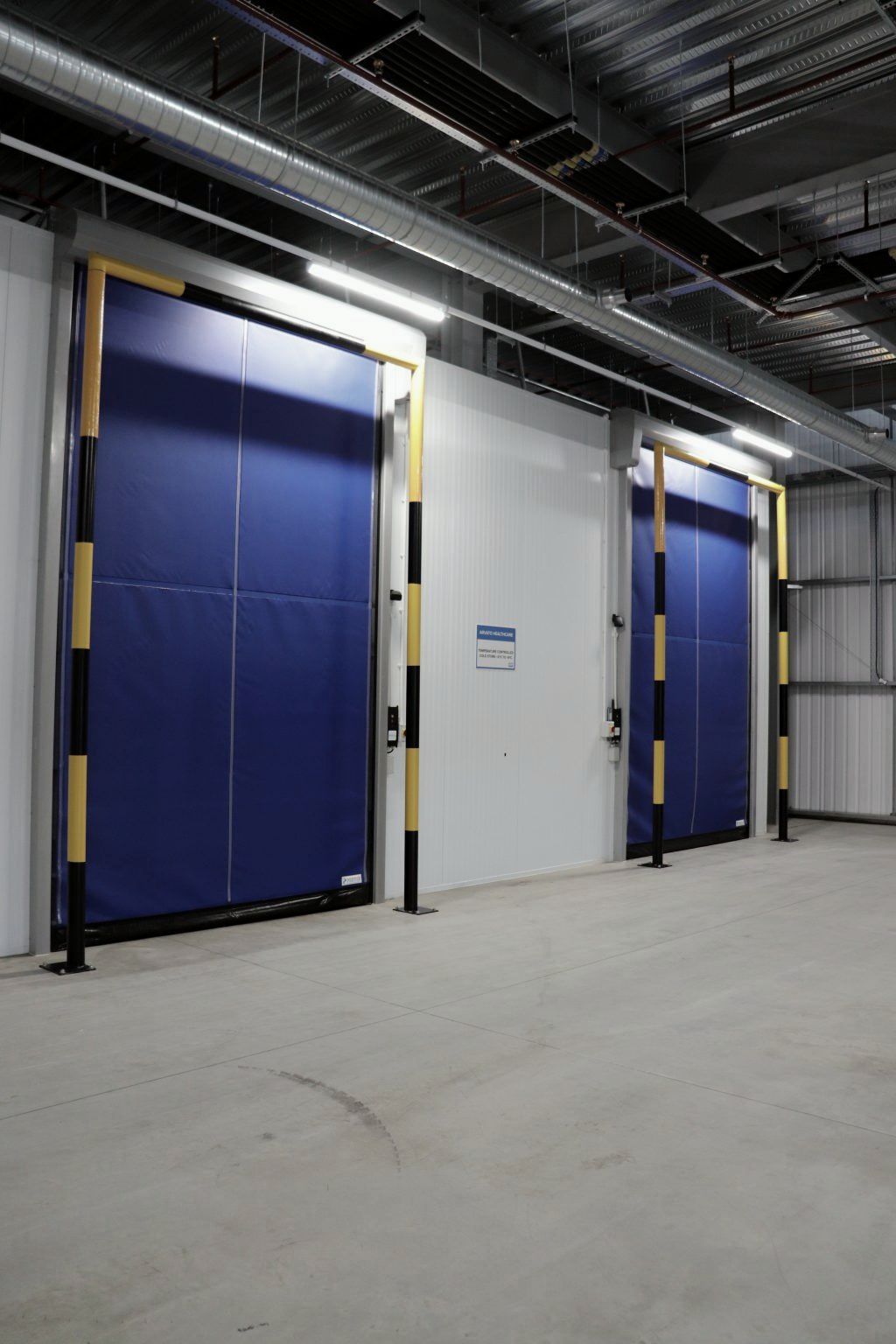
The door opens hundreds of times a day, and every opening lets in hot, humid air. On frozen rooms, failed frame heaters let seals freeze to the frame and ice build around the opening, until the door is left propped open.
Why doors matter more than they look
Every time a door opens, cold, dense air falls out through the bottom of the opening and warm air flows in at the top. In a Dubai summer that warm air carries a lot of moisture, which ends up as frost on the evaporator and ice around the frame. On a busy room, the air coming in through the door can be one of the largest parts of the whole heat load.
Frame heaters and seals on frozen rooms
On freezer doors, a heater wire runs around the frame to stop the seal freezing to it. When the heater fails, the seal sticks, tears and stops sealing. Ice builds around the opening, the door gets harder to close, and eventually someone props it open.
Pressure relief
Close the door on a freezer and the warm air that came in cools and contracts, pulling the room into a slight vacuum. Without a pressure relief valve the door can be very hard to open again, and the pressure difference strains the panels. On frozen rooms the relief valve is heated so it cannot ice shut.
What you’ll see
- Ice on frames and thresholds
- Torn, flattened or frozen seals
- Doors that are hard to open just after closing
- Evaporators icing up between defrosts
- Doors propped open because they are hard to use
Getting doors right
- Choose the door for the traffic: hinged for light use, sliding for pallets, high-speed doors where forklifts pass all day
- Strip curtains or air curtains behind busy doors
- An anteroom or chilled dock in front of frozen stores with heavy traffic
- Heated frames and heated pressure relief on every frozen room
- Door-open alarms with a sensible delay
- Seals, heaters, closers and alarms checked on every maintenance visit
Ice round the door? It is usually a heater, a seal or the wrong door for the traffic. We can survey it and put it right.
Book a free survey